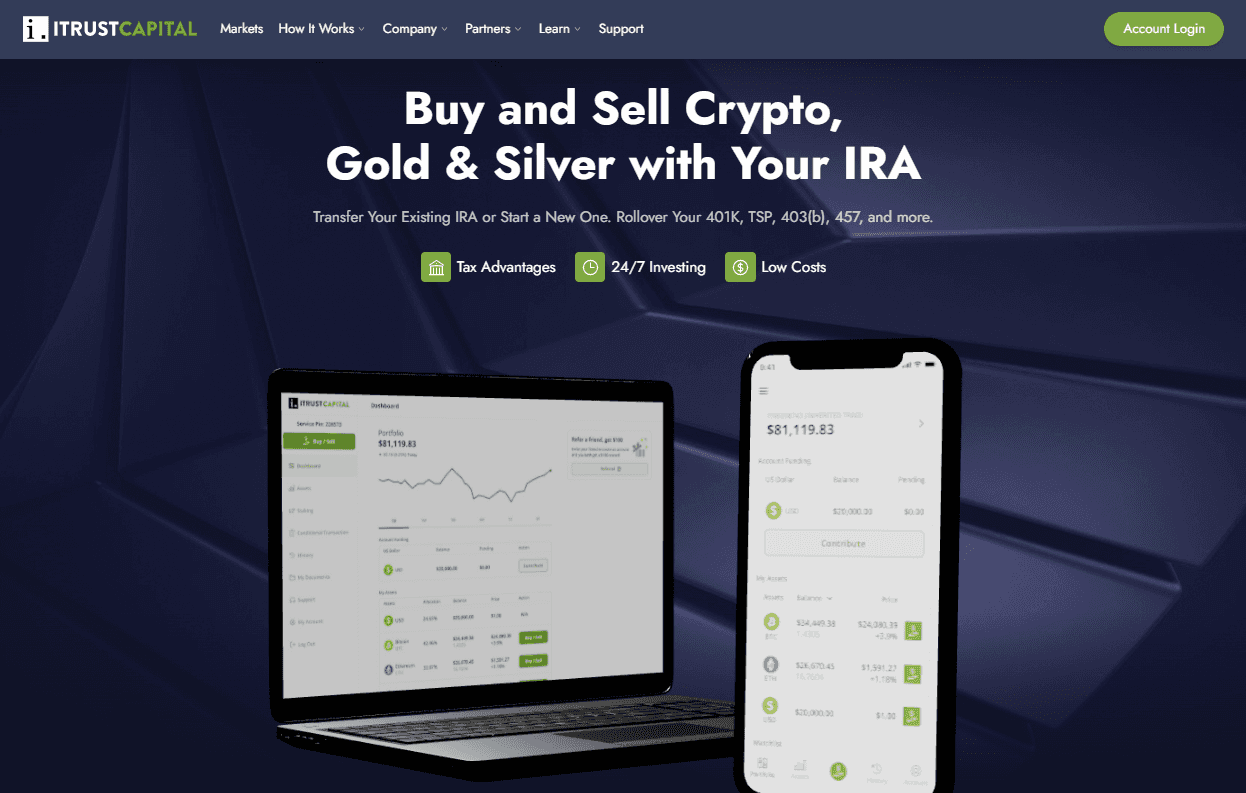
iTrustCapital Wallet: Overview and Guide
iTrustCapital is a financial technology platform designed to help users invest in cryptocurrencies and precious metals, particularly within tax-advantaged retirement accounts like self-directed IRAs. It is not a traditional crypto wallet where you control private keys; instead, it provides a custodial service where assets are securely held by trusted institutions. iTrustCapital also offers a taxable account called the Premium Custody Account (PCA) for users who want to hold and trade crypto outside of retirement accounts.
1. Understanding iTrustCapital
iTrustCapital is structured as a fintech platform that combines:
Crypto IRAs: Retirement accounts that allow crypto and precious metals investments under tax-advantaged rules.
Premium Custody Accounts (PCA): Taxable accounts that provide a safe way to hold crypto or metals with institutional-grade custody.
The key difference from a standard crypto wallet is that you do not control the private keys; custody is handled by institutional partners. This setup emphasizes security and regulatory compliance but limits the flexibility of self-custody wallets.
2. How Assets Are Custodied
iTrustCapital uses qualified custodians and institutional storage providers to secure assets:
For retirement accounts, assets are held by a qualified custodian that ensures compliance with IRS regulations.
Crypto assets are stored with established custodians using advanced security measures such as cold storage, multi-party computation, and hardware security modules.
Accounts are segregated, meaning client assets are separate from iTrustCapital’s own funds, which helps protect users in the unlikely event of company insolvency.
In the PCA, assets are held in a “closed-loop” system where crypto cannot be transferred externally; withdrawals are made in USD only.
This custody structure makes iTrustCapital highly secure, but it differs from traditional self-custody wallets because users cannot freely control or move the crypto outside the platform.
3. Key Features and Benefits
Institutional-Grade Security: Assets are stored with custodians that provide cold storage, advanced encryption, and multi-layer security protocols, reducing the risk of online hacks.
Segregated Accounts: Client funds are held separately from the company’s funds to minimize risk.
Closed-Loop PCA: PCA accounts prevent direct crypto withdrawals to external wallets, protecting users from phishing and unauthorized transfers.
24/7 Trading Access: Users can buy and sell crypto and metals at any time, giving flexibility while maintaining security.
Tax-Advantaged Retirement Accounts: Crypto IRAs allow users to hold crypto within a retirement account, offering potential tax benefits.
Simplified Fees: iTrustCapital charges transaction fees on crypto buys and sells, with no ongoing maintenance fees for accounts.
Support and Custodian Reliability: The platform provides customer support and uses reputable custodians with audits and institutional backing.
4. Limitations and Trade-offs
No Private Key Control: Users rely on iTrustCapital and their custody partners; you do not hold private keys yourself.
Limited Flexibility in PCA: Crypto held in PCA accounts can only be withdrawn in USD; transferring crypto to an external wallet is not possible.
U.S.-Only Platform: Designed for U.S. residents due to retirement account regulations and USD banking rules.
Insurance and Protection Limits: While institutional custodians carry insurance, the coverage per account or asset is not always fully transparent.
Transaction Fees: Fees apply to buying and selling crypto, which can add up if you trade frequently.
Less Freedom Compared to Self-Custody: Users cannot fully control the crypto, unlike with a personal hardware or software wallet.
5. What “Wallet” Means in iTrustCapital
When people refer to an “iTrustCapital wallet,” they are describing the platform’s custodial accounts rather than a self-custody wallet.
Crypto IRAs: Assets are held by a qualified custodian with strict regulatory oversight.
PCA Accounts: Funds are stored in a secure closed-loop system, where withdrawals are USD-only.
In both cases, users trade and manage their crypto through iTrustCapital, but the private keys remain with the custodians, not with the user.
6. Who Should Use iTrustCapital
Suitable for:
U.S. residents seeking tax-advantaged retirement crypto exposure.
Users who prefer institutional custody over self-custody.
Investors looking for a simpler setup without worrying about seed phrases or cold storage.
Those who want 24/7 access to buy/sell crypto and precious metals with professional backing.
Not suitable for:
Users wanting full control of private keys.
People who want to move crypto freely to external wallets or exchanges.
Non-U.S. residents, due to U.S.-centric regulations.
Investors who need fully transparent insurance coverage.
7. Security and Best Practices
Always secure your iTrustCapital account credentials.
Treat login credentials and personal information as sensitive; phishing attempts are possible.
Regularly review account activity and transactions for unusual behavior.
Understand the limits of custodial protection; while secure, custody is not the same as holding crypto independently.
8. Summary
iTrustCapital provides a secure and regulated environment to invest in cryptocurrencies and precious metals, particularly for retirement accounts. Its custodial system reduces many risks associated with crypto ownership, like hacking or phishing, but comes with trade-offs: users give up private key control and external wallet flexibility.
For U.S.-based investors seeking convenience, security, and tax-advantaged exposure to crypto, iTrustCapital can be a solid choice. However, those who prioritize full self-custody and complete control over their crypto may prefer hardware wallets or other self-custody solutions.